
Best Time to Post on Instagram
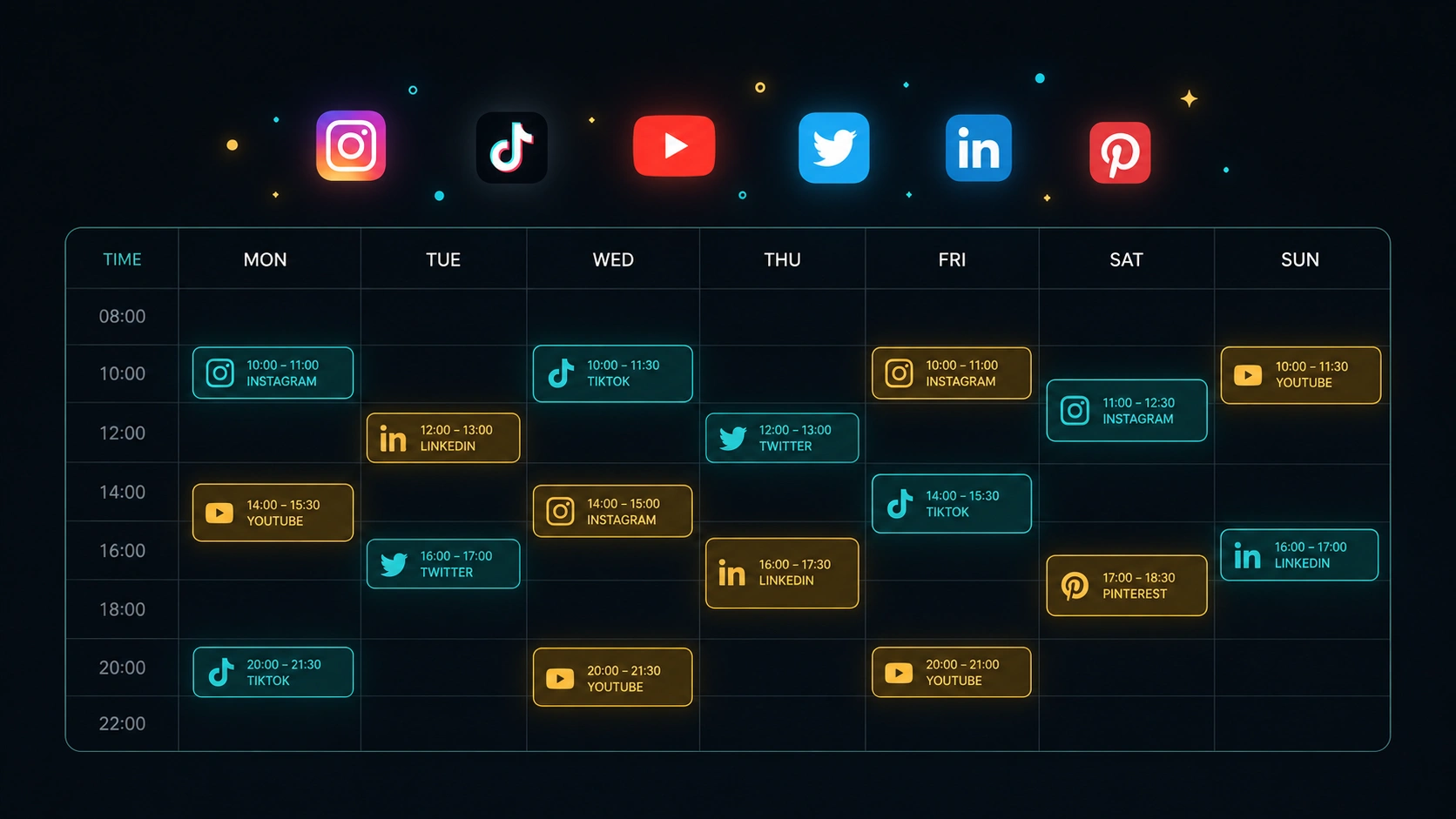
Posting at the wrong time on Instagram in 2026 doesn’t just hurt one post — it can suppress your reach for days. Instagram’s algorithm weighs engagement velocity in the first 30–60 minutes heavily, meaning a great post published when your audience is offline has no chance to build the momentum needed for broader distribution.
Here’s what the data actually says, based on the largest studies available: Buffer’s analysis of 9.6 million posts, Sprout Social’s study of nearly 2 billion engagements across 307,000 profiles, and Metricool’s analysis of 24 million posts from 375,000 accounts worldwide.
The Best Times to Post on Instagram in 2026 (Overall)
Across the major 2026 datasets, three time slots consistently outperform everything else:
- Wednesday at 12 PM (local time) — highest single-day engagement slot across Buffer’s 9.6M post analysis
- Thursday at 9 AM (local time) — second strongest overall, particularly strong for Feed posts and Reels
- Tuesday–Thursday evenings 6–9 PM — consistently the highest-volume engagement window globally, with the 8–9 PM hour showing the heaviest active traffic in Metricool’s 24M post study
The worst days: Friday and Saturday consistently show the lowest engagement across all major studies. If you must post on weekends, Sunday evening (7–9 PM local) outperforms both Friday and Saturday by a significant margin.
Best Posting Times by Day
Here’s how each day of the week breaks down, based on 2026 data:
| Day | Best time slot | Notes |
|---|---|---|
| Monday | 6–9 AM / 12–1 PM | Recovery day — use for warm-up content, not major launches |
| Tuesday | 7–9 AM / 1–7 PM | One of the three strongest days; great for Reels |
| Wednesday | 12 PM / 6–9 PM | Best single day overall — use for priority posts |
| Thursday | 9 AM / 8–9 PM | Highest single-hour peak (9 PM) in multiple datasets |
| Friday | Avoid (low engagement) | Lowest reach day — save strong content for Mon–Thu |
| Saturday | 9–11 AM / 6–8 PM | Leisure scrolling — lifestyle and personal content only |
| Sunday | 7–9 PM | Underrated evening window — good for inspirational content |
Best Time to Post Reels in 2026
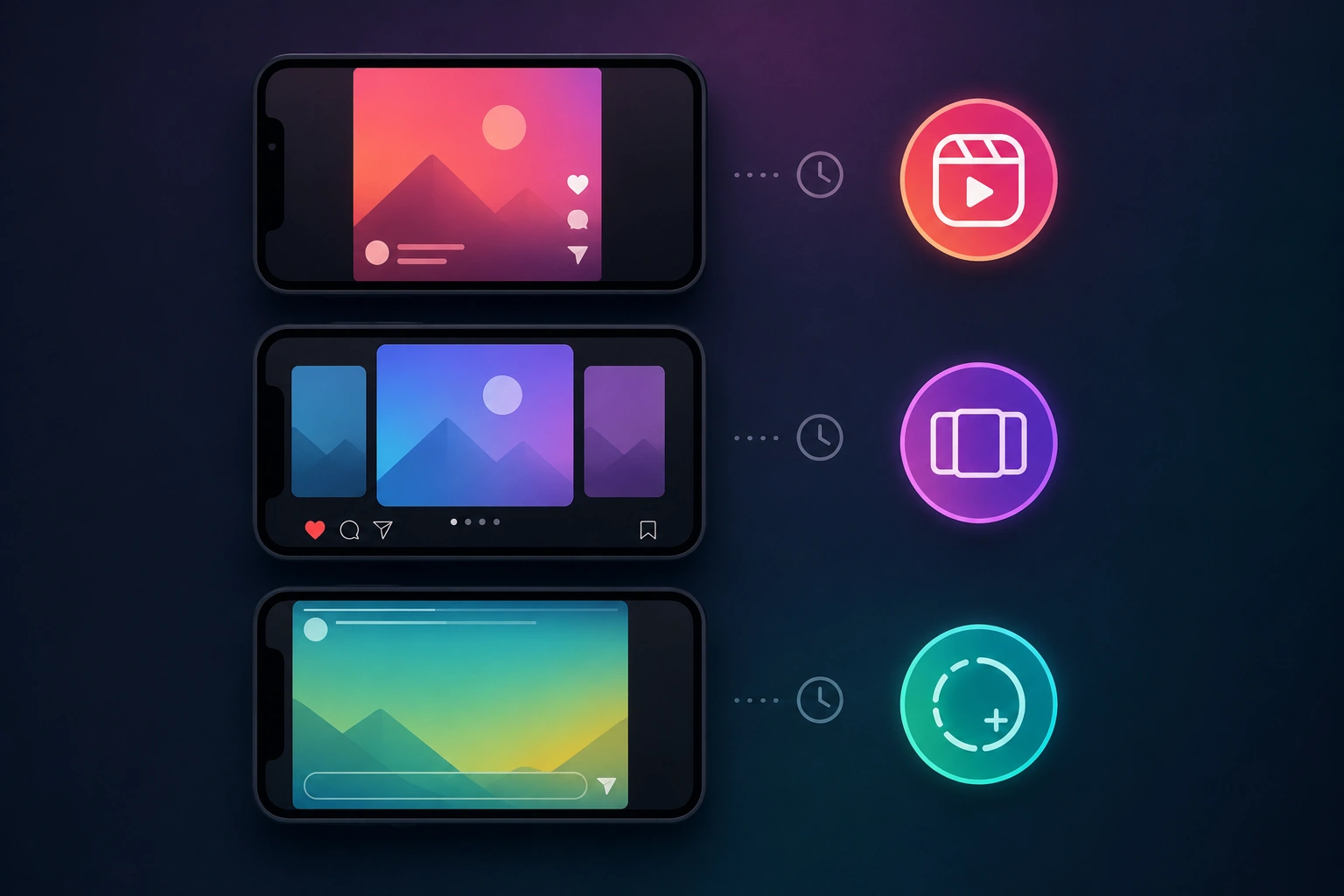
Reels behave differently from static posts. The algorithm evaluates Reels primarily on watch completion rate and replay rate — meaning early engagement velocity matters even more than for Feed posts. If a Reel doesn’t pick up momentum in the first hour, it rarely recovers.
The strongest Reels windows based on 2026 data:
- 6–9 AM on weekdays — catches early scrollers during their first-of-day check, with less competition than midday
- 7–9 PM Tuesday through Thursday — the highest-volume evening window when users are actively browsing for entertainment
- Monday at 12 AM — Later’s dataset showed this as the highest Reels engagement slot specifically (late-night Sunday browsing carries into Monday’s algorithm window)
One shift that affects Reels timing in 2026: Instagram now measures total watch time including replays, not just 3-second threshold views. A short Reel that gets replayed multiple times will outperform a longer one watched once. This means the quality of your hook affects not just whether people finish the video, but whether they watch it again — which directly changes how timing interacts with performance.
Best Time to Post Carousels
Carousels have a structural advantage in 2026: Instagram introduced secondary distribution in February 2026, giving carousels with high swipe-through rates a second round of non-follower reach 48–72 hours after the original post. This means your carousel’s performance window is longer than a Reel’s.
Best time slots for carousels: 11 AM–1 PM and 7–9 PM on weekdays. Carousels require more attention than Reels, and the lunch window works because people have time to swipe through multiple slides. Avoid posting carousels during commute hours — short attention spans mean low swipe-through rates, which signals poor performance to the algorithm.
Best Time to Post Stories
Stories behave differently because they stay visible for 24 hours, which softens the timing urgency somewhat. That said, Stories posted during high-activity windows get more immediate views, and immediate views drive the algorithm to push your Story higher in the queue for people who haven’t tapped it yet.
Best times for Stories: 6–9 PM on weekdays for engagement-focused Stories (polls, questions, reactions). For purely informational Stories, timing matters less — post whenever the information is relevant. Morning Stories (7–9 AM) work well for polls and interactive content as people scroll during their commute.
There’s a strategic angle here that most creators miss: Story interaction rate in 2026 is a signal that feeds back into Feed ranking. Accounts with high Story engagement see their Feed posts ranked higher for those same users. Using Stories consistently as an interaction tool, not just a broadcast channel, has compound effects across the entire account.
Best Posting Times by Niche
Audience behavior varies significantly by content category. The general benchmarks above are a starting point, but these niche-specific windows reflect how different audiences use Instagram:
| Niche | Best window | Why |
|---|---|---|
| Fitness & wellness | 5–7 AM weekdays | Pre-workout planning mindset |
| Food & lifestyle | 11 AM–1 PM / 6–8 PM | Lunch and dinner browsing |
| Tech & tools | 11 AM–3 PM weekdays | Professional discovery during work breaks |
| Fashion & beauty | 6–9 PM weekdays | After-work shopping mindset |
| Travel & adventure | 9–11 AM Sat–Sun | Weekend leisure browsing |
| Business & education | 7–9 AM Tue–Thu | Morning learning habit before work |
Why “Best Time to Post” Advice Has Limits in 2026
One thing the data consistently shows: generic posting time advice is less impactful than it used to be. Instagram’s algorithm now personalizes what each user sees based on their individual behavior — the same post can perform at 4.8% engagement for one segment of your followers and flatline for another, and the algorithm will only push it to the first group regardless of when you posted.
The more important variable is your specific audience’s active hours — not global averages. Use Instagram’s Professional Dashboard (tap Insights → Total Followers → scroll to Most Active Times) to see when your actual followers are online by hour and day. Check it monthly, because audience behavior shifts seasonally.
The global benchmarks in this guide are a reliable starting point — especially for accounts under 10,000 followers who don’t yet have enough data to draw their own conclusions. Once you have a few months of posting history, your own account data will always be more accurate than any published study.
The One Thing That Matters More Than Timing
Consistency outperforms perfect timing every time. An account that posts at 80% of the optimal window on a consistent schedule will outperform one that posts at exactly the right time sporadically. In 2026, Instagram’s algorithm now has a longer recovery window after posting gaps — meaning an inconsistent schedule has a more lasting effect on reach than in previous years.
The practical approach: pick two or three weekly slots in the high-engagement windows above that you can hit consistently, build your content calendar around those slots, and then use your own Insights data to refine from there. Timing is a multiplier on good content — it doesn’t rescue weak content, but it reliably amplifies strong content that’s already built for shares and replays.
More articles
Instagram Algorithm 2026
If your Instagram reach dropped this year, you’re not imagining it. Instagram rolled out its most significant algorithm overhaul since the introduction of Reels in early 2026 — and the creators who don’t understand what changed are quietly losing 30–50% of their organic distribution without knowing why. This guide breaks down every confirmed change, what […]
The Best Place to Buy Instagram Followers Safely in 2026
As of April 2026, the dominant visual social platform has evolved. Organic reach is now heavily dictated by short-form video recommendations rather than the chronological feeds of your existing network. While acquiring a synthetic subscriber base is a widespread tactic for boosting initial “social proof,” it is critical to understand the core reality: these purchased […]
150+ Best Vacation Instagram Captions to Make Your Travel Photos Pop
Planning your dream vacation is exciting, but finding the perfect words to accompany those stunning photos can be challenging. Whether you’re lounging on a tropical beach, exploring ancient ruins, or hiking breathtaking mountains, the right caption can elevate your Instagram post from ordinary to unforgettable. You’ve packed your bags for the family vacation, created memories, […]